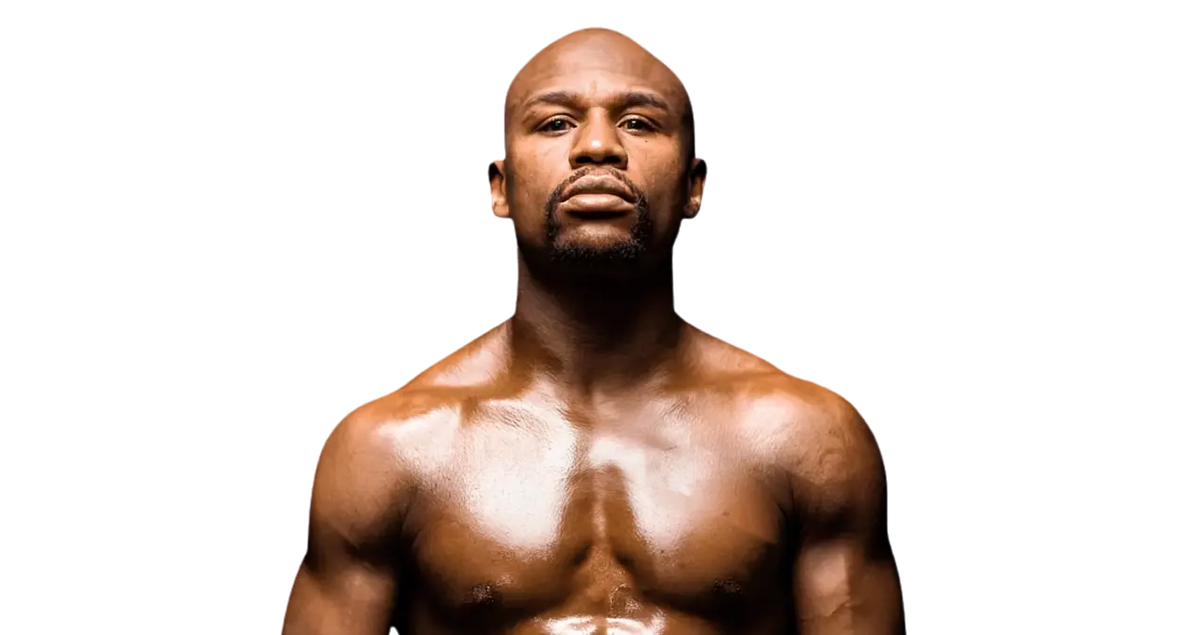
Floyd Mayweather Jr. is an American professional boxer who competed from super featherweight to light middleweight and retired in 2017 with a perfect professional record of 50 wins and no defeats, the most professional wins any boxer has recorded without a loss or a draw.
Floyd Mayweather Quick Facts
| Record | 50-0-0 (W-L-D) 27 KO |
|---|---|
| Status | Retired |
| Nickname | Money |
| Division | Super featherweight to light middleweight |
| Nationality | United States |
| Age | 49born |
| Height | 173 cm 5 ft 8 in |
| Weight | 66.7 kg 147 lb (welterweight limit) |
| Pro debut | |
| Years active | 1996 to 2017 21 years |
| Team | Mayweather Boxing Club, Las Vegas |
| Social | @floydmayweather |

Early Life and the Grand Rapids Gym
Floyd Joy Mayweather Jr. was born in Grand Rapids, Michigan, on , and was registered at birth under the surname Sinclair. Boxing was already the family trade. His father, Floyd Mayweather Sr., was a welterweight good enough to share a ring with Sugar Ray Leonard on ABC's Wide World of Sports on , losing by stoppage in the tenth round. Two of his uncles boxed professionally as well: Roger Mayweather, who won world titles in two weight classes, and Jeff Mayweather.
That detail is usually written up as colour. It is closer to a technical explanation. Mayweather did not come to the sport through a beginner's programme and a set of borrowed headgear. He came to it through three professionals who had all been hurt in a ring and who taught, first and above everything, how not to get hit. The defensive shape that later made him almost impossible to score against was not a stylistic choice made in his twenties. It was the first thing he was taught. For most fighters, the route from the amateur ranks into professional boxing begins with learning to attack and ends with learning to defend. His went the other way around.
What stayed constant through the childhood was the gym, and the identity of the man in it changed more than once. Coaching duties passed between Floyd Sr. and Roger, and that handover repeated itself throughout the professional career. It is the reason the corner in a Mayweather fight was never a neutral piece of furniture. Two of the three men who shaped his boxing were also arguing about who should be shaping it.
The Amateur Career and the Atlanta Olympics
Mayweather's amateur record is one of the few numbers about him that reputable sources genuinely dispute. It is most commonly given as 84 wins and 6 defeats. The record databases carry that figure but note that three further defeats were subsequently identified, which would make it 84-9, and other reference sources give 84-8. The honest answer is that the win column is agreed and the loss column is not, and anyone quoting a single number is quoting a convention rather than a verified count.
What is not in dispute is the hardware. He won National Golden Gloves titles in 1993 and 1994, and he boxed for the United States at featherweight at the Atlanta Olympics.
He came home with a bronze. He should probably have come home with something better. In the semi-final he lost a decision to Serafim Todorov of Bulgaria that was contested at the time and has been contested ever since, and Olympedia's own biography of him describes it as controversial without qualification. Todorov went on to take silver. Mayweather turned professional within months and never fought as an amateur again.
The Olympic result is worth holding onto because of what it did to the professional career. Every fighter who turns over carries a story about being robbed. Mayweather carried a documented one, and he built a professional method around removing the judges' discretion entirely. If you never give a scoring official a close round to interpret, you never lose the way he lost in Atlanta.
The Professional Career
Twenty-one years, fifty fights, no defeats and no draws. That is the whole professional career in one line.
The First Professional Fight
Mayweather made his professional debut on against Roberto Apodaca and stopped him in the second round. He was 19. The debut is the first row of the record table below, and it matters for one reason beyond sentiment: the debut date sits before every other bout on the record, which is the arithmetic anchor for the twenty-one-year career span in the quick facts above.
The first two years were a conveyor belt. He fought once more in 1996, ten times in 1997 and seven times in 1998, and stopped four opponents inside the first round between January and May 1997. Ten of his first twelve professional opponents did not hear the final bell.
Climbing Five Weight Classes
Mayweather won world titles in five divisions, and the World Boxing Council confirms five WBC world championships on its own belts alone: super featherweight, lightweight, super lightweight, welterweight and super welterweight. The progression, and the two-year gaps in it, tell you how deliberately it was managed.
The first title came at super featherweight on , when Genaro Hernandez's corner pulled him out after the eighth round. Mayweather was 21 and 17-0, and he had needed only 72 rounds of professional boxing to get there. He was the first member of the 1996 United States Olympic squad to win a professional world title.
He defended that belt eight times before the weight became unmanageable, moved up to lightweight and took the WBC title from Jose Luis Castillo on . Three defences later he moved again, to super lightweight, and stopped Arturo Gatti in his corner after six rounds on .
Welterweight is where he stayed. He took the IBF belt from Zab Judah on and the WBC belt from Carlos Baldomir on , and 147 pounds is the division he competed in longest and the weight the quick facts table above reports for that reason. The excursion up to 154 came twice: against Oscar De La Hoya on , and against Miguel Cotto on . Both were title fights. Neither turned into a residence.
Signature Wins and Rivalries
Five fights carry the professional legacy, and they are not the five with the biggest revenue.
Diego Corrales, . This is the best performance of Mayweather's career and the one that is quoted least. Corrales was a former IBF junior lightweight champion, unbeaten, taller, and the biggest puncher at 130 pounds. He had also come in two pounds over the limit and spent ninety minutes in a sauna to make it, which is context that belongs in any honest account of the night. Mayweather put him down five times, three in the seventh round and twice in the tenth, every knockdown off the left hook. Referee Richard Steele stopped it at 2:19 of the tenth with Corrales' corner already moving to throw in the towel. Corrales landed 60 punches from 205 thrown, a CompuBox record for futility at the time. Corrales argued afterwards that he was still coherent. He was, and it did not matter, because he had spent ten rounds unable to find a target.
Jose Luis Castillo, . The closest professional call of the career, and the fight that made him lightweight champion. Mayweather took a unanimous decision by 115-111, 115-111 and 116-111 in twelve foul-strewn rounds, and referee Vic Drakulich took a point from each man along the way, from Castillo in the eighth and from Mayweather in the tenth. The MGM Grand booed the verdict, and plenty of ringside observers had Castillo ahead. What settles the argument is what Mayweather did next: he gave Castillo an immediate rematch in December of the same year and won it without dispute. Fighters who get away with one do not usually volunteer for the second.
Oscar De La Hoya, . The fight that turned a great fighter into a business. Mayweather moved up to 154 and took the WBC super welterweight title on a split decision, Chuck Giampa scoring it 116-112 and Jerry Roth 115-113 for Mayweather, Tom Kaczmarek 115-113 the other way. It drew a then record 2.45 million pay-per-view buys and a then record live gate of $18,419,200, and generated $136,853,700 in domestic pay-per-view revenue against total gross receipts of about $165 million. De La Hoya took a $52 million purse. Mayweather took $25 million, and never fought for a smaller share again.
Canelo Alvarez, . A 152-pound catchweight at the MGM Grand Garden Arena against a 23-year-old who had not lost. The catchweight is the detail that decided it before the bell: Alvarez had been fighting at 154 and was made to come down two pounds, which cost him more than the poundage suggests. Mayweather boxed him at range, took the second half without difficulty, and won on a majority decision, Craig Metcalfe scoring 117-111 and Dave Moretti 116-112 while C.J. Ross saw it level at 114-114.
Manny Pacquiao, . Five years of negotiation produced twelve rounds and a unanimous decision: Dave Moretti 118-110, Glenn Feldman 116-112, Burt Clements 116-112. Mayweather was 38, it was the forty-eighth fight of the career, and he boxed it exactly as he had boxed the previous forty-seven, on the back foot with the jab controlling the entry. The commercial figures for the night are in the earnings section below, and they remain the number every promoter in the sport still measures an event against.
What the McGregor Fight Actually Was
The bout with Conor McGregor on is routinely described as an exhibition. It was not. It was a sanctioned professional boxing match under Nevada rules, contested at 154 pounds with ten-ounce gloves, and it is bout number fifty on the official record. Mayweather stopped McGregor in the tenth round. The disclosed purses filed with the commission were $100 million for Mayweather and $30 million for McGregor.
The confusion is understandable, because everything Mayweather has done in a ring since then genuinely has been an exhibition, and those bouts do not appear on the 50-0 record at all. The distinction is the whole reason the record table below stops in August 2017.
Current Status
As of , Floyd Mayweather Jr. is alive, is 49 years old, and has not competed in a sanctioned professional boxing match since he stopped Conor McGregor in . His professional record is verified at 50-0-0 with 27 stoppages as of .
He has boxed eight exhibitions since retiring: Tenshin Nasukawa in Saitama on , Logan Paul in Miami Gardens on , Don Moore on the Burj Al Arab helipad in Dubai on , Mikuru Asakura in Saitama on , Deji Olatunji in Dubai on , Aaron Chalmers at the O2 Arena in London on , John Gotti III in Sunrise, Florida on , and Gotti again at the Arena CDMX in Mexico City on . The Mexico City rematch is his most recent appearance in a ring of any kind as of . None of the eight counts toward the professional record.
On he announced through an exclusive agreement with CSI Sports and Fight Sports that he intends to return to professional competition, saying he still has what it takes to set more records in the sport. No opponent, date or venue for that professional return has been confirmed.
Three bouts have been announced and none has happened. An exhibition against Mike Tyson was announced in for in the Democratic Republic of the Congo, reset for , and then postponed again to a later slot in 2026 after Tyson broke a hand in training, with no date or venue announced since. An exhibition against the Greek kickboxer Mike Zambidis at the Telekom Center in Athens, floated for , was blocked by litigation over the Tyson and Pacquiao contracts. A Pacquiao rematch was announced in for at Sphere in Las Vegas on Netflix; Sphere's calendar was subsequently given to an Eagles residency, Mayweather said publicly that any Pacquiao bout would be an exhibition while Pacquiao's promoters said signed contracts specified a sanctioned professional fight, and by the Las Vegas date had been reassigned to a different promoter's card. Announced dates in this phase of his career have moved repeatedly, and every booking above should be read as provisional.
Fighting Style
Mayweather won 23 of his 50 professional fights on the judges' cards, which is the statistic that produces the lazy description of him as a runner. It is the wrong reading. He was a counter puncher who fought at a range of his own choosing and who scored heavily in the second half of fights, which is a different thing from avoiding one.
Stance, Shoulder Roll and the Check Hook
He fought orthodox, at 173 cm with a 183 cm reach, which gave him ten centimetres of arm over frame and let him hold opponents at a distance his own height should not have allowed.
The defensive system is the philly shell, also called the shoulder roll: lead shoulder high and turned toward the opponent, lead arm across the body, rear glove at the cheek. It gives up the body to protect the head and it is only worth doing if you can read a punch early enough to roll it. Almost nobody can. Mayweather could, and the reason the guard worked for him and fails for imitators is that the shell is not a block. It is a platform for the counter that follows. The rear hand is already home, so the straight right off a rolled left hook travels a shorter distance than anything the opponent can answer with.
Two punches define the career. The first is that lead right, thrown off the shell as the opponent commits. The second is the check hook, a hook thrown while stepping away from an incoming attacker so that the punch and the exit are the same movement. Ricky Hatton walked onto it on , was knocked off balance, and carried his own momentum into the ring post while Mayweather stepped clear. Mayweather has said he learned the punch as an amateur in Michigan. It ended the fight in the tenth.
Against the shell, only one approach ever worked for any length of time, and Castillo found it: refuse the head, go to the body, and accept the counters as the price. Marcos Maidana came closest to repeating it on , by refusing to let Mayweather set the distance at all: he walked him to the ropes, kept his own head on Mayweather's chest, and threw in the places the guard does not reach. Both men were beaten more clearly in the rematch, which is the other half of the pattern. Mayweather lost rounds while he was still reading an opponent, and he did not tend to lose the same rounds twice.
How Many Knockouts Mayweather Scored
Mayweather scored 27 stoppages in 50 professional fights, a stoppage rate of 54 percent. The distribution is the interesting part, and it is why the shape of his career is misread.
| Phase | Fights | Stoppages | Rate |
|---|---|---|---|
| Fights 1 to 25 | 25 | 19 | 76 percent |
| Fights 26 to 50 | 25 | 8 | 32 percent |
Nineteen of his first twenty-five opponents were stopped. Eight of the second twenty-five were. The knockout puncher and the points fighter are the same man at different weights: he carried the power of a super featherweight up through four divisions and it did not travel with him, so the method changed while the results did not.
The Record and the Titles
Fifty fights, fifty wins, no defeats, no draws and no contests. The table below lists every one of them, most recent first. No boxer in the record books has more professional wins without a loss or a draw.
The titles came in five divisions, and the World Boxing Council alone recognises Mayweather as a WBC world champion at super featherweight, lightweight, super lightweight, welterweight and super welterweight, a run documented in full by the sanctioning body. He was elected to the International Boxing Hall of Fame in and enshrined with the combined classes at Canastota in 2021.
Anyone tracking the divisional moves against the poundage will want the boxing weight classes laid out in order, because the ladder from 130 to 154 pounds runs through five of them.
| Date | Opponent | Result | Method |
|---|---|---|---|
| Conor McGregor | Win | TKO 10 | |
| Andre Berto | Win | UD 12 | |
| Manny Pacquiao | Win | UD 12 | |
| Marcos Maidana | Win | UD 12 | |
| Marcos Maidana | Win | MD 12 | |
| Canelo Alvarez | Win | MD 12 | |
| Robert Guerrero | Win | UD 12 | |
| Miguel Cotto | Win | UD 12 | |
| Victor Ortiz | Win | KO 4 | |
| Shane Mosley | Win | UD 12 | |
| Juan Manuel Marquez | Win | UD 12 | |
| Ricky Hatton | Win | TKO 10 | |
| Oscar De La Hoya | Win | SD 12 | |
| Carlos Baldomir | Win | UD 12 | |
| Zab Judah | Win | UD 12 | |
| Sharmba Mitchell | Win | TKO 6 | |
| Arturo Gatti | Win | RTD 6 | |
| Henry Bruseles | Win | TKO 8 | |
| DeMarcus Corley | Win | UD 12 | |
| Phillip N'dou | Win | TKO 7 | |
| Victoriano Sosa | Win | UD 12 | |
| Jose Luis Castillo | Win | UD 12 | |
| Jose Luis Castillo | Win | UD 12 | |
| Jesus Chavez | Win | RTD 9 | |
| Carlos Hernandez | Win | UD 12 | |
| Diego Corrales | Win | TKO 10 | |
| Emanuel Augustus | Win | TKO 9 | |
| Gregorio Vargas | Win | UD 12 | |
| Carlos Gerena | Win | RTD 7 | |
| Justin Juuko | Win | KO 9 | |
| Carlos Rios | Win | UD 12 | |
| Angel Manfredy | Win | TKO 2 | |
| Genaro Hernandez | Win | RTD 8 | |
| Tony Pep | Win | UD 10 | |
| Gustavo Cuello | Win | UD 10 | |
| Miguel Melo | Win | TKO 3 | |
| Sam Girard | Win | KO 2 | |
| Hector Arroyo | Win | TKO 5 | |
| Angelo Nunez | Win | TKO 3 | |
| Felipe Garcia | Win | KO 6 | |
| Louie Leija | Win | TKO 2 | |
| Jesus Roberto Chavez | Win | TKO 5 | |
| Larry O'Shields | Win | UD 6 | |
| Tony Duran | Win | TKO 1 | |
| Bobby Giepert | Win | TKO 1 | |
| Kino Rodriguez | Win | TKO 1 | |
| Edgar Ayala | Win | TKO 2 | |
| Jerry Cooper | Win | TKO 1 | |
| Reggie Sanders | Win | UD 4 | |
| Roberto Apodaca | Win | TKO 2 |
Genaro Hernandez, Diego Corrales, Jose Luis Castillo, Arturo Gatti, Zab Judah, Carlos Baldomir, Oscar De La Hoya, Ricky Hatton, Juan Manuel Marquez, Shane Mosley, Miguel Cotto, Canelo Alvarez and Manny Pacquiao all held recognised world titles, and two of the names on the list, Castillo and Maidana, took him to cards that could reasonably have gone the other way. The eight post-retirement exhibitions are listed in Current Status above and none of them appears in this table.
Net Worth and Earnings
Forbes reported that Floyd Mayweather earned $915 million between 2010 and 2019, more than any other athlete on the planet across that decade and $115 million clear of the next name on the list. That is the most reliable large number attached to him, because it is a published earnings figure from an outlet that does this work rather than a net worth estimate.
The distinction matters. Published net worth figures for Mayweather vary enormously and almost all of them come from celebrity valuation sites with no access to filings, tax returns or the books of his promotional company. No reliable net worth figure for him exists in the public record, and any article that gives you one to the nearest million is inventing precision. What can be documented is earnings, and the documented earnings are extraordinary on their own.
Forbes has published three figures worth repeating. It put his 2015 haul at $300 million, the highest single-year total on its athlete list that year. It attributed a $275 million payday to him for the McGregor fight in its 2018 ranking. And it placed him first among all athletes for the 2010s at the $915 million total above.
Separately from estimates, four purse and revenue figures are on the public record through athletic commission filings and promoter disclosures:
- $100 million disclosed purse for Conor McGregor, filed with the Nevada State Athletic Commission for . McGregor's disclosed purse was $30 million.
- $25 million purse for Oscar De La Hoya on , against De La Hoya's $52 million, on an event that grossed roughly $165 million.
- A $72,198,500 live gate for the Pacquiao fight on , from 16,219 tickets sold, alongside more than $400 million in pay-per-view revenue.
- A $600,000 payment to Juan Manuel Marquez on , at $300,000 per pound, after Mayweather weighed 146 for a bout contracted at a 144-pound catchweight.
The two disclosed purses in that list total $125 million for two nights of work. The Marquez payment is the smallest number here and the most revealing: he chose to miss the contracted weight and paid the penalty rather than take it off, which is a decision only a fighter with complete control of his own promotion gets to make.
He built that control with a single cheque. In , ten years into the career, Mayweather paid $750,000 to buy himself out of his promotional contract with Top Rank rather than accept an $8 million purse to fight Antonio Margarito. Twelve months later he took $25 million for De La Hoya, and from that point he took percentages of total event revenue instead of guaranteed fees. He was paid $80 million for the Canelo Alvarez fight in on that basis. The $750,000 is the most consequential number in this section, and it is the one nobody quotes.
Personal Life
Mayweather is one of the best known names in the sport's history, and the name was already in boxing before he was born. Three of his relatives fought professionally and two of them trained him, which makes his family less a biographical footnote than a working part of the career.
Floyd Mayweather Sr.
Floyd Mayweather Sr. is the fighter's father and was for long stretches his trainer. He boxed professionally as a welterweight and met Sugar Ray Leonard at the Civic Center in Providence, Rhode Island on , weighing 146 pounds to Leonard's 147, and was stopped at 2:16 of the tenth round after being dropped twice in the eighth. He said afterwards that he had damaged his right hand in the opening round.
He worked his son's corner in two separate spells, and the relationship between the two men was publicly difficult for years before it settled. The technical inheritance is not in doubt: the shoulder roll, the high lead shoulder and the refusal to trade are all things Floyd Sr. taught and still teaches.
Roger Mayweather
Roger Mayweather was the fighter's uncle and his head trainer for most of the championship years. He was a serious fighter in his own right, nicknamed "The Black Mamba", with a professional record of 59-13 across an eighteen-year career and world titles in two divisions: the WBA and lineal super featherweight titles from 1983 to 1984, and the WBC light welterweight title from 1987 to 1989.
He began training his nephew in 1996, stepped aside when Floyd Sr. took over, and returned to the corner in 2000 after his own final professional bout. He died on at the age of 58.
Mayweather's Children
Floyd Mayweather has four children: Koraun, Iyanna, Zion Shamaree and Jirah Milan. He has spoken about all four publicly over many years, including on his approach to schooling and on wanting them to have manners and to stay positive. They are adults, and beyond their names and their relationship to him this page does not publish details about them.
The other thing worth stating plainly is that Floyd Mayweather is alive. The question is searched often enough to be worth answering directly, and the answer as of is that he is 49 and appearing regularly in boxing news through Mayweather Promotions, which has continued to sign and develop professional fighters since he stopped competing.