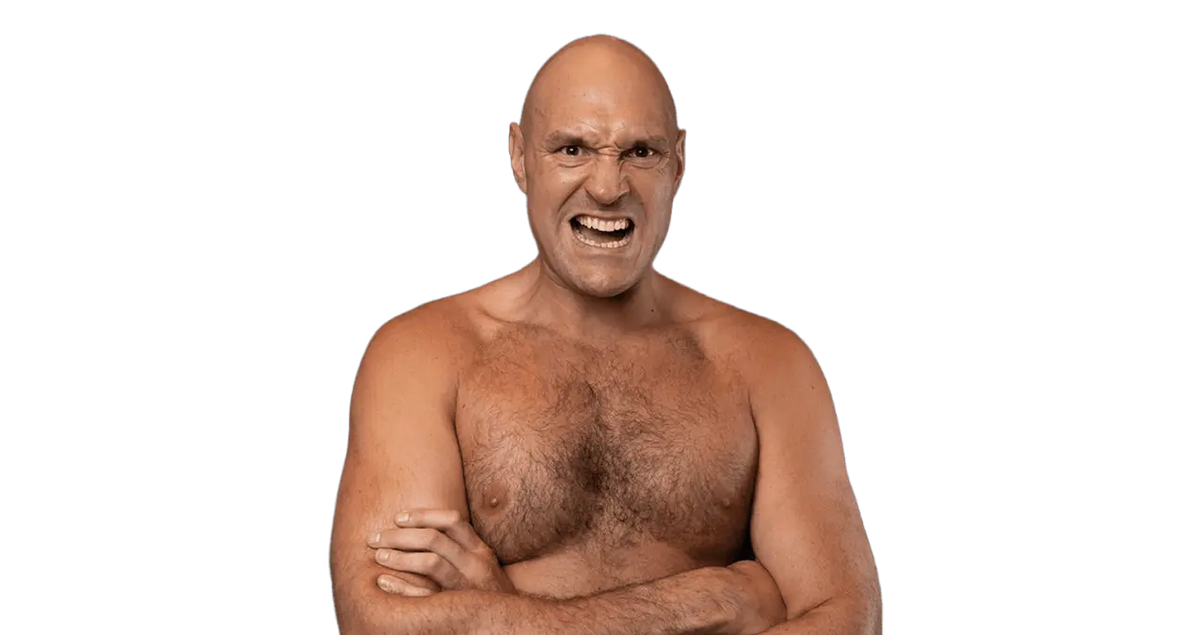
Tyson Fury is a British heavyweight boxer who beat Wladimir Klitschko in Düsseldorf in 2015 to take the WBA, IBF, WBO and lineal world titles. He came out of retirement in January 2026 and was active as of September 2026.
Tyson Fury Quick Facts
| Record | 36-2-1 (W-L-D) 25 KO |
|---|---|
| Status | Active |
| Nickname | The Gypsy King |
| Division | Heavyweight |
| Nationality | United Kingdom |
| Age | 38born |
| Height | 206 cm 6 ft 9 in |
| Weight | 120.2 kg 265 lb (weigh-in, July 2026) |
| Pro debut | |
| Years active | 2008 to present 18 years |
| Team | SugarHill Steward (Kronk), Morecambe |
| Social | @tysonfury |

Early Life and the Fury Family Name
Tyson Luke Fury was born on in Wythenshawe, Manchester, three months premature and weighing about a pound. His father has told the story to BBC Sport more than once: the doctors offered little hope, and John Fury answered by predicting a seven foot heavyweight champion of the world and naming the baby after Mike Tyson, who at that moment held every major belt in the division.
The family is Irish Traveller on both sides. John Fury was born in Tuam, County Galway. Tyson’s maternal line runs through Belfast and County Tipperary, which is why he was eligible to box for Ireland as an amateur and did so three times. He grew up in Styal, Cheshire, in a household where fighting was a trade rather than a pastime. Two of his forebears, Uriah Burton and Bartley Gorman, were each known in their own day as King of the Gypsies, an informal bare-knuckle title passed by reputation. That is where the ring name comes from. Fury adopted it himself; no promoter handed it to him.
He was in his father’s gym at ten years old and boxed out of Jimmy Egan’s Boxing Academy in Wythenshawe, which is the ordinary starting point for a British professional: an amateur club, a card of unpaid contests, then a licence.
John Fury and Where the Name Came From
John Fury was born on in Tuam and fought as Gypsy John Fury, first in unlicensed bouts and then as a licensed professional between April 1987 and June 1995, finishing 8-4-1. The best known name on his record is Henry Akinwande, later WBO heavyweight champion, who stopped him in three rounds in October 1991. He trained his son from roughly the age of ten.
In 2011 John Fury was convicted of wounding with intent to cause grievous bodily harm after a brawl in which a man lost an eye. He was sentenced to eleven years and released in February 2015. The consequence for his son’s career was practical: John Fury was out of the corner for the years that carried Tyson from British champion to a world title fight, and his brother Peter Fury ran the camp instead, including the night in Düsseldorf.
Amber Fury, His Mother
Tyson Fury’s mother is Amber Fury, John Fury’s first wife, and she has stayed further outside public life than anyone else in the family. Fury has said in interviews that he went looking for a photograph of her online and found none, and that she has never sat at ringside for one of his fights. He has also spoken about what she went through, telling interviewers that his mother had fourteen pregnancies and that four of the children survived. A sister, Ramona, was born in December 1997 and lived only days. No middle name or maiden name for Amber Fury appears in any authoritative source, and this page does not supply one.
His Brothers, and the Two Different Hughie Furys
Fury has five brothers. Three are full brothers through Amber Fury: John Jr, known in the family as John Boy and a former boxer himself; Hughie; and Shane, who has stayed out of the professional ranks. Two are half brothers through John Fury’s second wife Chantal: Roman, professional since October 2022, and Tommy, born , who made his professional debut on and appeared on Love Island the following year. Reporting is not unanimous here. People and Grazia give the three full brothers as John Jr, Hughie and Shane, which reconciles with Fury’s own account of four surviving children; other outlets list John Jr as a half brother or omit Hughie. Treat the split as reported rather than settled.
Two separate people in this family are called Hughie Fury, and search engines mix them constantly. The first is Tyson’s uncle, Hughie Fury the horse dealer and coach, born in 1964, who trained Tyson early in his career and died on at the age of fifty after breaking his shin moving a caravan and developing a pulmonary embolism during surgery; an inquest ruled the death accidental. The second is Hughie Fury the professional heavyweight, born on , who is Tyson’s first cousin and the son of Peter Fury. They are uncle and cousin respectively, a generation apart, and only one of them boxed for a living. Peter Fury, a third name in the same orbit, is Tyson’s uncle and was his trainer from 2014 through the Klitschko win.
The Amateur Years, Two Flags and the Games He Never Reached
Fury finished his unpaid career at 31-4 with 26 stoppages, and he boxed under two flags while doing it. In England he represented Jimmy Egan’s Boxing Academy. For Ireland he was registered with Holy Family Boxing Club in Belfast and the Smithboro club in County Monaghan, an arrangement his maternal grandmother’s Tipperary origins made possible and which he has described as needing him to prove his Irishness on paper.
The medals came quickly. Bronze at the 2006 world junior championships, gold at the EU junior championships in May 2007, silver at the European juniors two months later, and the ABA super heavyweight title in 2008. That last one should have opened a door and did not. Great Britain could enter a single super heavyweight at the Beijing Games and the place went to David Price, whom Fury had knocked down in an amateur bout two years earlier. Fury told the Sunday Telegraph he was not selected because of politics. He then tried to qualify for Ireland and failed. Rather than wait four years for London, he turned professional at twenty.
That decision reads differently now than it did then. An Olympic medal is the standard launchpad for a British heavyweight, and Fury reached a world title without one, which is rarer than the record books make it look.
Turning Professional and the Road to a World Title
Seven years and twenty four fights separate the debut from the Klitschko night. The first half of that run was built on volume rather than matchmaking: six fights in the seven months after the debut, three in 2010, four in 2011. The British system he came through hands out its titles in order, and he collected them in order.
The Nottingham Debut
Fury made his professional debut on at the National Ice Centre in Nottingham, on the undercard of Carl Froch against Jean Pascal for the WBC super middleweight title. His opponent was Bela Gyongyosi of Hungary, then 3-9-2. Fury stopped him at 2:14 of the first round. He was twenty years old and had turned professional less than five months after the ABA final.
The English title came on against John McDermott, on a card in Brentwood, and the 98-92 card the referee turned in was disliked enough that the rematch was ordered. Fury settled that one on with a ninth round stoppage. On he took the British and Commonwealth belts from Dereck Chisora at Wembley Arena on a unanimous decision of 118-112, 117-111 and 117-111. The Irish heavyweight title followed against Martin Rogan in Belfast in April 2012. His first fight in the United States came on at the Theater at Madison Square Garden, where Steve Cunningham dropped him in the second round and was knocked out in the seventh at 2:55.
Klitschko, Wilder and the Nights That Set the Price
The Klitschko fight on at the Esprit Arena in Düsseldorf is the one that made him. Fury weighed 247 lb, his lightest since 2012, and boxed a fight built entirely on denying Wladimir Klitschko a target: hands down, upper body moving, switching between orthodox and southpaw often enough that Klitschko never settled his jab. The cards read 115-112, 115-112 and 116-111. He took the WBA Super, IBF, WBO and IBO belts, The Ring championship and the lineal title in one night, away from home, against a man who had held a version of the title since April 2006.
He kept the IBF belt for ten days. On the IBF stripped him for declining a mandatory defence against Vyacheslav Glazkov, which clashed with a contractual Klitschko rematch. The remaining belts he gave up himself in October 2016 while receiving treatment, and The Ring took its championship back in February 2018 for inactivity. Nobody beat him for any of them.
Then came Deontay Wilder, three times, and the first meeting is the fight worth slowing down for. On at Staples Center in Los Angeles, in his third fight back after two and a half years away, Fury outboxed the WBC champion for long stretches and did not get the decision. Alejandro Rochin scored it 115-111 for Wilder, Robert Tapper 114-112 for Fury and Phil Edwards 113-113, which made it a split draw and left Wilder the belt.
Two things about that night are routinely reported wrongly. The first is Tapper’s card, which was announced in the ring as 114-110 for Fury. His own round by round tallies add up to 114-112, and the photographed official card shows it. The error did not change anything, because Tapper had Fury in front either way, but the announced figure is still repeated.
The second is the twelfth round. Wilder landed a right hand followed by a left hook and Fury went down flat on his back with roughly two minutes left. He was not counted out and he was not saved by the bell. Referee Jack Reiss has described exactly what he saw: at the count of five the eyes opened, the knee bent, the gloves squeezed, and Fury was on his feet at nine. Reiss then made him walk three steps laterally and come back before he would allow the fight to continue. Fury landed clean right hands in the closing seconds of the round. He had also been dropped in the ninth by a short left hook followed by an overhand right, and had risen from that one too. CompuBox credited Wilder with 71 landed from 430 thrown, and Fury with 84 from 327.
The rematch on at the MGM Grand Garden Arena was the opposite fight. Fury had changed trainer to SugarHill Steward and walked Wilder onto his front foot from the opening bell, leaning on him, turning him, and taking his legs before his chin. Wilder’s corner threw the towel in the seventh. The cards at the stoppage read 59-52, 58-53 and 59-52, all for Fury, with a point deducted in the fifth for holding by referee Kenny Bayless. The live gate of $16.9 million was a Nevada record for a heavyweight fight, and 15,816 people were in the building. Fury left with the WBC belt, The Ring championship and the lineal title.
Wilder III on at the T-Mobile Arena was the wildest of the three. Fury was down twice in the fourth, dropped Wilder in the third and tenth, and finished it with a right hand at 1:10 of the eleventh. The unofficial cards at the stoppage were 95-91, 95-92 and 94-92. Dillian Whyte was stopped in six at Wembley Stadium on in front of 94,000 people, and Dereck Chisora was stopped in ten at Tottenham Hotspur Stadium on in front of 59,789, a figure the club itself confirmed.
The correction most often needed about Tyson Fury: the Francis Ngannou fight was a sanctioned professional bout and it counts on his record. It is frequently written up as an exhibition. It was not. The contest on at the Kingdom Arena in Riyadh was scheduled for ten rounds, sanctioned by the British Boxing Board of Control as the host commission, and recorded on both men’s professional records. The WBC granted Fury permission to take it without forfeiting his belt and put a commemorative strap on the line, but no world title was at stake. Fury was dropped by a left hook in the third and won a split decision, 96-93 and 95-94 in his favour with the third judge at 95-94 for Ngannou. The confusion is traceable: in the week before the fight, BoxRec had received no sanctioning notification and reporters raised the possibility that it would not land on either record. That was resolved before the first bell, and no sanctioning body has ever treated the fight as an exhibition.
Oleksandr Usyk handed him the first two defeats of his career. On in Riyadh, Usyk took a split decision, 115-112 and 114-113 on two cards against 114-113 the other way, after hurting Fury badly in the ninth. The rematch on was unanimous and clear at 116-112 across all three cards. Fury weighed 281 lb for it, a career high, and announced his retirement shortly afterwards.
Where His Career Stands
As of , Tyson Fury is active, holds no world title, and has a professional record of 36-2-1 with 25 wins inside the distance. He announced his return on Instagram on after roughly a year away.
He has boxed twice since. On he beat Arslanbek Makhmudov over twelve rounds at Tottenham Hotspur Stadium on cards of 120-108, 120-108 and 119-109, in front of a crowd Turki Al-Sheikh put at 64,500, in a fight streamed by Netflix with no belt at stake. That result was reported at the time by Al Jazeera. On he stopped Mariusz Wach at the Max Muay Thai Stadium in Pattaya, Thailand, when Wach’s corner retired him on the stool after the seventh; the bout was WBC sanctioned, carried the newly created WBC Humanitarian title, drew about 1,500 spectators and was not broadcast live.
A fight with Anthony Joshua was announced as agreed on by promoter Eddie Hearn and by Turki Alalshikh, targeted at the final quarter of 2026 and sold to Netflix. As of no date and no venue have been officially confirmed. A date of at Madison Square Garden has been reported, with the venue addendum still unsigned and both camps publicly disputing terms. Announced heavyweight fights move, and this one has already been announced once without being scheduled.
How He Fights: Range, the Long Guard and the Switch
Fury is the largest man ever to hold a lineal heavyweight title and almost everything technical about him follows from that. At 206 cm with an 85 inch reach he can stand at a distance where a normal heavyweight cannot reach him, and he spends most of a fight there, touching with a long jab that is a range finder rather than a weapon.
The Jab, the Lean and What Happens Inside
He boxes from an orthodox stance by default and switches feet when the geometry stops working. Against Klitschko he switched constantly, and the effect was less about landing from the new stance than about resetting the lead foot position so Klitschko’s jab kept arriving at a target that had moved. Very few heavyweights that size can change feet without losing balance. Fury does it mid-exchange.
The stance change is only half of it. The other half is what he does when the distance collapses. He does not tie up in the conventional way; he leans, takes hold behind the head, walks his opponent into the ropes and turns him off, then steps out with the jab already extended, in whichever stance the exchange left him, orthodox or southpaw. It is legal, it is exhausting to fight through, and it is why so few opponents have managed a sustained inside campaign against him.
His fighting weight tells its own story. He was 247 lb against Klitschko in 2015, 256.5 lb against Wilder in 2018, 273 lb for the Wilder rematch when Steward wanted him heavier and marching forward, 277 lb for the trilogy fight, 281 lb for the second Usyk fight, and 265 lb on the scales in July 2026. The spread of more than thirty pounds is not carelessness. Each number came with a different plan, and the heaviest of them came with the worst night.
What has beaten him is instructive. Usyk did not out-muscle him or out-reach him. Usyk moved off angles, refused to stand where the long guard could reach, and kept punching in threes and fours while Fury was still measuring. The clinching that neutralised Chisora and Wilder does not work on a man who will not stand still to be held.
Every Professional Fight and Every Belt
Tyson Fury’s professional record stood at 36 wins, 2 losses and 1 draw, with 25 wins by stoppage, when it was verified on . The table below lists all 39 bouts, most recent first. Several widely used reference pages had not caught up with the July 2026 result on that date and still showed 35-2-1 or 34-2-1.
| Date | Opponent | Result | Method |
|---|---|---|---|
| Mariusz Wach | Win | RTD 7 | |
| Arslanbek Makhmudov | Win | UD 12 | |
| Oleksandr Usyk | Loss | UD 12 | |
| Oleksandr Usyk | Loss | SD 12 | |
| Francis Ngannou | Win | SD 10 | |
| Dereck Chisora | Win | TKO 10 | |
| Dillian Whyte | Win | TKO 6 | |
| Deontay Wilder | Win | KO 11 | |
| Deontay Wilder | Win | TKO 7 | |
| Otto Wallin | Win | UD 12 | |
| Tom Schwarz | Win | TKO 2 | |
| Deontay Wilder | Draw | SD 12 | |
| Francesco Pianeta | Win | PTS 10 | |
| Sefer Seferi | Win | RTD 4 | |
| Wladimir Klitschko | Win | UD 12 | |
| Christian Hammer | Win | RTD 8 | |
| Dereck Chisora | Win | RTD 10 | |
| Joey Abell | Win | TKO 4 | |
| Steve Cunningham | Win | KO 7 | |
| Kevin Johnson | Win | UD 12 | |
| Vinny Maddalone | Win | TKO 5 | |
| Martin Rogan | Win | TKO 5 | |
| Neven Pajkic | Win | TKO 3 | |
| Nicolai Firtha | Win | TKO 5 | |
| Dereck Chisora | Win | UD 12 | |
| Marcelo Luiz Nascimento | Win | KO 5 | |
| Zack Page | Win | UD 8 | |
| Rich Power | Win | PTS 8 | |
| John McDermott | Win | TKO 9 | |
| Hans-Joerg Blasko | Win | TKO 1 | |
| Tomas Mrazek | Win | PTS 6 | |
| John McDermott | Win | PTS 10 | |
| Aleksandrs Selezens | Win | TKO 3 | |
| Scott Belshaw | Win | TKO 2 | |
| Mathew Ellis | Win | KO 1 | |
| Lee Swaby | Win | RTD 4 | |
| Daniil Peretyatko | Win | RTD 2 | |
| Marcel Zeller | Win | TKO 3 | |
| Bela Gyongyosi | Win | TKO 1 |
Titles won across the career:
- WBA (Super), IBF, WBO and IBO heavyweight titles, won 28 November 2015. IBF stripped 8 December 2015; the remainder vacated in October 2016.
- The Ring heavyweight championship, won 28 November 2015, stripped for inactivity in February 2018. Won again 22 February 2020 and relinquished in August 2022.
- Lineal heavyweight championship, won 28 November 2015 and given up in October 2016. Won again 22 February 2020 and lost on 18 May 2024.
- WBC heavyweight title, won 22 February 2020 and lost on 18 May 2024.
- European heavyweight title, won 29 November 2014.
- British heavyweight title, won 23 July 2011 and again on 29 November 2014.
- Commonwealth heavyweight title, won 23 July 2011.
- Irish heavyweight title, won 14 April 2012.
- English heavyweight title, won 11 September 2009 and again on 25 June 2010.
- WBO Inter-Continental title, won 7 July 2012 and again on 15 June 2019. WBO International title, won 29 November 2014.
What Tyson Fury Has Earned, and What Is Only Estimated
Published estimates of Tyson Fury’s net worth cluster between roughly £150 million and $200 million, and the only figure from an established compiler is the £162 million The Sunday Times Rich List gave him in May 2026 on his first appearance in its under forties section. Regional press reporting the list placed him 229th among British people under forty. He had not appeared on the 2025 edition at all, so that number is a debut rather than a trend.
Two outlets with published methodologies have measured his annual earnings. Forbes ranked him third among all athletes in the world in May 2025 on estimated earnings of $146 million, $140 million of it from boxing and $6 million from off-field income, in a twelve month window that contained both Usyk fights. Sportico, working independently, put him third for calendar 2024 on $147 million. Two compilers landing within a million dollars of each other is the strongest earnings evidence in his career. Forbes had previously placed him eleventh in 2020 on $57 million, and he did not appear in the 2026 top ten, a list Canelo Alvarez entered at second on $170 million.
Commission filings give harder numbers, and they are much smaller than the headlines, because a filed purse is a contractual base rather than a total. The California commission recorded $3 million for the first Wilder fight. Nevada recorded $5 million for the rematch and $6 million for the trilogy bout, while noting that both men had guaranteed earnings above $25 million once pay-per-view percentages were counted. The Dillian Whyte fight is documented differently and better: Queensberry won the purse bid at $41,025,000, the WBC took its ten per cent, and the formula left Fury 80 per cent of the remainder, or $29,538,000. Separately, Companies House filings for Tyson Fury Ltd showed a profit of £79 million for the year to September 2024 and total assets just under £160 million, a statutory record rather than an estimate.
Fury’s largest reported single paydays put him in the small group of boxers, Floyd Mayweather among them, to have been paid nine figures for one night. They run in this order. The Independent reported that Fury took around $105 million for the first Usyk fight from a total purse near $150 million, a figure it flagged as reports rather than confirmation; promoter Bob Arum said on the record only that it would exceed $100 million. The same paper put the Ngannou fight at $50 million, and Fury himself later described it publicly as nearly £50 million. Gareth A. Davies of The Telegraph put the third Chisora fight at $20 million. GB News reported that Netflix guaranteed $25 million for the Makhmudov fight in April 2026. The Wach fight is the outlier: The Telegraph reported that Fury took no payment at all and that the event raised about £179,000 for the Father Ray Foundation, while Sky Sports described a reduced purse offset by the Netflix arrangement.
One honest limitation belongs on any page that gives these numbers. Net worth figures for athletes are third party estimates produced without access to tax filings or private accounts, and the higher ones circulating for Fury come from celebrity net worth aggregators with no stated method. None of his Saudi-staged fights was governed by a commission with public disclosure obligations, which means every figure for Ngannou and both Usyk fights is journalism or promoter briefing rather than record. The documented purses and the Companies House accounts are the reliable numbers, and they are the ones this page leads on.
Paris Fury, Seven Children and a House in Morecambe
Fury lives in Morecambe, Lancashire, where he keeps a private gym near the football ground, and the family home is where most of the Netflix series At Home with the Furys is filmed. The wider family remains close to the better known names in British boxing: two half brothers box professionally, a first cousin fought at heavyweight, and cousins Nathan Gorman and Isaac Lowe both turned professional.
Paris Fury, and How They Met
Paris Fury, born Paris Mulroy on in Doncaster, married Tyson Fury on , two weeks before his professional debut. They met at a mutual friend’s wedding when she was fifteen. She has written two bestselling memoirs, Love and Fury in 2021 and How Does She Do It? in 2023, appears in At Home with the Furys, and is a regular panellist on ITV’s Loose Women. The couple renewed their vows in New York in April 2013 and again in the south of France in August 2025 with all seven children present.
Is Tyson Fury Married to His Cousin?
No. Paris Fury was born Paris Mulroy, into a Doncaster Traveller family separate from the Furys, and took the Fury surname on marriage in 2008. Her parents are Lynda and Jimmy Mulroy, and Lynda Mulroy wrote about Tyson in Travellers’ Times in February 2016 describing him purely as her son-in-law. The couple met as strangers at a wedding. Neither has ever said on the record that they are related, and the claim does not appear in any established news reporting; it circulates on short-form video platforms. What is true is that both families are Irish Travellers, a community small enough that shared surnames and distant connections are common, which is probably where the idea started.
The Seven Fury Children
Tyson and Paris Fury have seven children, and the family has made all seven names public themselves through the Netflix series, Paris Fury’s books and their own interviews. The daughters are Venezuela, the eldest, along with Valencia and Athena. The sons are Prince John James, Prince Tyson Fury II, Prince Adonis Amaziah and Prince Rico Paris. Fury explained the repetition on camera: he is the king, so the boys are princes until they earn a name of their own. The youngest, Prince Rico Paris, was announced by Paris Fury to OK! Magazine in October 2023; the middle name honours her, and the first name is for Tyson’s late cousin Rico Burton. This page names them because their parents did, and gives nothing else about them.
Two things are commonly miscounted into that seven. Bambi is the daughter of Tommy Fury and Molly-Mae Hague, which makes her Tyson’s niece rather than an eighth child. And an old quote of Fury’s referring to three children still circulates; it simply predates four of the births.